
Deer Season Is Coming to Luzerne County: Here’s What Happens If You Hit One.
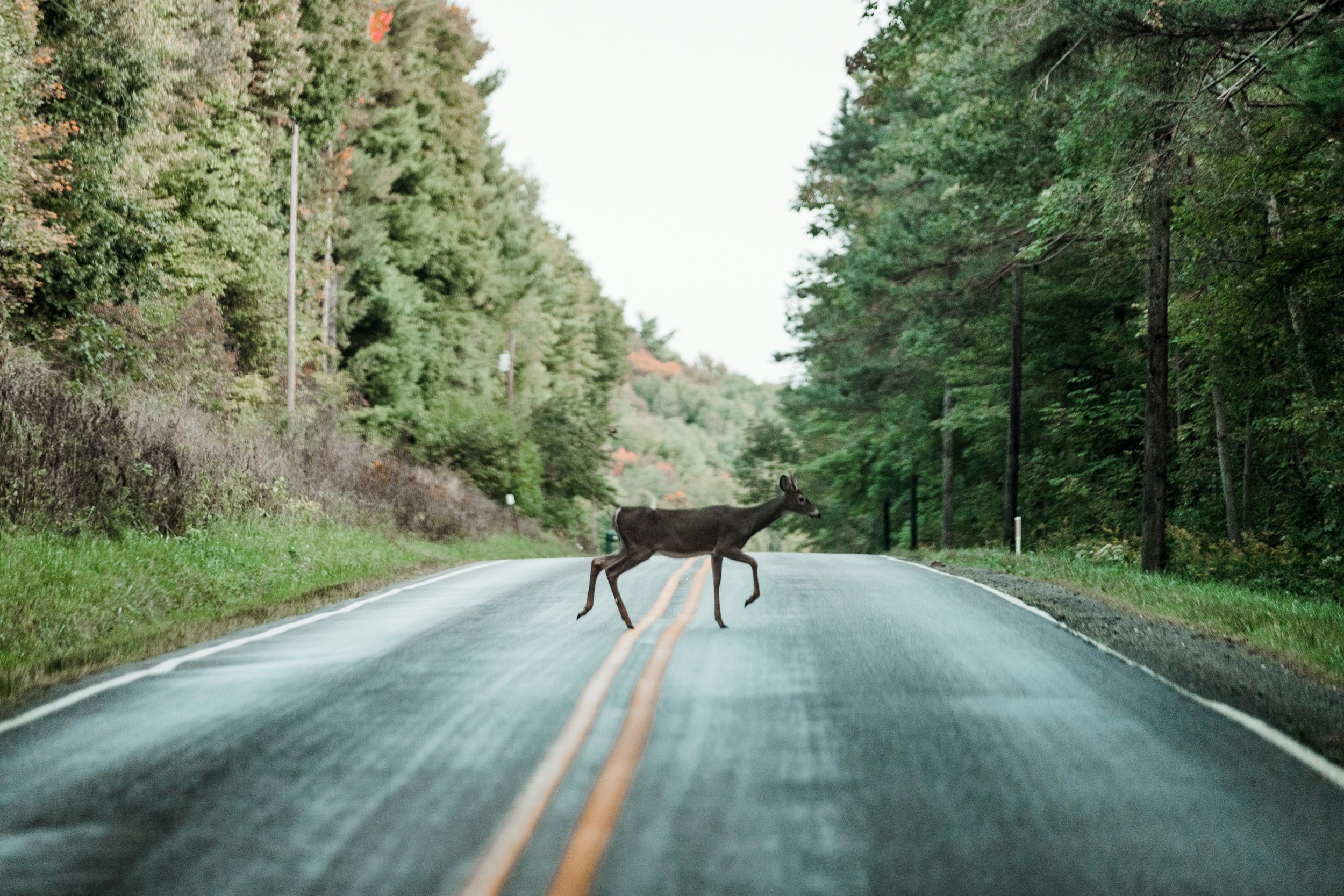
Every fall, the same thing happens on the roads around here. The deer start moving, the evenings get darker earlier, and the calls start.
Pennsylvania is not an average state for this. Recent State Farm analysis put Pennsylvania at roughly 147,000 to 148,000 estimated animal collision claims in a single year — the highest raw claim count in the country — with the state ranking among the top five nationally for the odds of any given driver hitting an animal. The most dangerous months, consistently, are November, then October, then December.
Statewide archery season opens October 3 this year. The rut follows, and with it the period when deer move farthest and least predictably. Add the clock change at the start of November, which drops the evening commute into darkness, and you have the annual spike.
The most important thing happens before impact
Do not swerve.
This is counterintuitive and it matters more than anything else in this article. The safety guidance from insurers, state agencies and highway safety researchers is consistent: brake firmly, stay in your lane, and do not swerve to miss the animal.
The reason is that the deer is the smaller danger. Swerving is what puts vehicles into oncoming traffic, into guardrails, into trees, and into rollovers. A collision with a deer is usually a damaged vehicle. A collision with a tree at fifty miles an hour is something else entirely. The serious injuries in deer-related crashes frequently come from the avoidance maneuver rather than from the deer.
If you see one deer, slow down
They rarely travel alone. A doe crossing ahead of you is often followed by others you have not seen yet. Ease off, and stay eased off for the next quarter mile.
After the collision
Get off the road safely, hazards on, and stay in the vehicle if traffic is moving — a second collision is a real risk on a dark rural road.
Do not approach an injured deer. A wounded animal is unpredictable and can cause serious injury.
Call it in. Report the crash to police, particularly if there is injury, disabling damage, or the animal is blocking a travel lane. A police report also becomes useful documentation for the insurance claim. Under Pennsylvania rules, if you want to keep the deer, you need a permit from the Game Commission — you cannot simply take it.
Photograph everything. The vehicle, the damage, the position on the road, the location, the time. This is the same evidence you would gather after any crash, and it is easy to skip when you are rattled.
Get checked if anything hurts. Deer collisions produce sudden, hard deceleration and airbag deployments. Delayed neck and back pain after these crashes is common.
Which coverage pays
This is the question almost everyone gets wrong, and the answer is good news.
Hitting an animal is generally a comprehensive claim, not a collision claim, under a standard Pennsylvania auto policy. Comprehensive covers a range of non-collision losses and typically carries a lower deductible.
But if you swerved and struck a tree, a guardrail or another vehicle, that is usually a collision claim instead — because the impact was with an object, not the animal. Same night, same deer, different coverage, and often a different deductible.
If you carry only liability coverage, damage from hitting a deer is generally not covered at all. Worth checking your declarations page before November rather than after.
When another driver is involved
Deer-related crashes frequently become multi-vehicle crashes. A driver ahead of you slams the brakes for an animal. A driver coming the other way swerves across the center line. A chain reaction develops on a dark two-lane road.
At that point it stops being an animal claim and becomes an ordinary negligence question: which driver failed to exercise reasonable care, and did that failure cause the collision. The presence of a deer does not automatically excuse a driver who was following too closely or travelling too fast for a dark road with known deer activity.
These are also the deer-related crashes that produce actual injuries, and they are worth having someone look at.
Practical steps for the next ten weeks
Slow down between dusk and dawn, particularly on rural two-lane roads and anywhere a wooded edge meets the pavement.
Use high beams when there is no oncoming traffic. Eye shine is often the first warning you get.
Take the deer crossing signs seriously. They are placed where collisions have actually happened.
Everyone buckles up, every trip. It is the single measure that most reduces injury severity in these crashes.
Check your comprehensive coverage and deductible now, while it is a five-minute phone call rather than a claim.
If you were hurt in a crash involving a deer — or, more often, in the crash that happened because someone else
was avoiding one — the attorneys at Joyce, Carmody & Moran can talk it through with you. There is no cost for
the first conversation and no obligation. More on what to do after a collision is in our Injury Help Center, which is
free to read and asks nothing of you.
